Minnesota License Plate options for drivers with qualifying disabilities can provide designated parking privileges and vehicle identification based on state requirements. Minnesota disability plates are issued through the Driver and Vehicle Services (DVS) process, with eligibility tied to approved disability documentation. Applicants may need certification from a licensed medical professional before receiving disability-related plates or certificates. Different plate options may apply based on the applicant’s needs, vehicle use, and parking privileges. Knowing the application requirements, documentation, fees, renewal rules, and replacement process can help applicants prepare the required paperwork.
Minnesota License Plate information for disability plates covers eligibility, application forms, documentation, fees, renewal periods, and authorized parking privileges. Qualified Minnesota residents can apply for disability plates through Driver and Vehicle Services, with medical certification required for qualifying conditions. Some disability plates may provide parking privileges for the vehicle connected to the applicant, based on state rules. Applicants should review current DVS requirements before submitting paperwork, since plate eligibility and documentation can vary by disability type. Clear information about these requirements helps vehicle owners prepare an accurate application.
Disability Plate Eligibility Requirements
Minnesota disability plate eligibility is based on specific disability and vehicle circumstances listed by Driver and Vehicle Services (DVS). The official PS2904 Application for Disability Plates states that the disabled applicant must have a permanent physical disability supported by the required documentation. Short-term, long-term, and temporary disability parking certificates do not qualify for disability plates.
Medical Statement or Proof of Disability
Applicants who do not have a disability parking certificate for a permanent disability must complete the applicable medical section of PS2904. This provides the required medical certification or medical statement supporting the applicant’s proof of physical disability. The health professional’s certification must meet the requirements stated on the current application.
Permanent Disability Certificate
A disability parking certificate issued for a permanent physical disability can be used in the disability plate application process. PS2904 asks for the certificate number of the disabled applicant. The form clearly states that long-term, short-term, and temporary certificates do not qualify for disability plates.
Specially Modified Vehicle Exception
Minnesota’s disability plate application materials include provisions for certain specially modified vehicles. The eligibility rules are not limited to a standard personal vehicle situation, so applicants with a specially modified vehicle should review the current DVS requirements and the applicable section of PS2904 before submitting documentation.
Insurance Information
Insurance is part of the vehicle registration requirements. PS2904 requires the insurance company name, policy number, and policy expiration date when applying for vehicle registration, re-registration, or ownership transfer. This information supports the registration transaction and is separate from the medical certification used to establish disability eligibility.
How to Apply for Minnesota Disability License Plates
A Minnesota disability plate application starts with confirming eligibility and preparing the correct paperwork. The Minnesota Driver and Vehicle Services (DVS) materials identify PS2904 as the standalone Application for Disability Plates. The standard PS2010 Application for Special Plates should not be used for disability plate transactions. The application includes a medical statement completed by a qualified health professional, along with vehicle and registration information. The completed paperwork is handled through the appropriate county treasurer or deputy registrar, rather than through this website.
- Minnesota Disability License Plates Application:
- https://dps.mn.gov/divisions/dvs/vehicle/license-plates/disability-license-plates
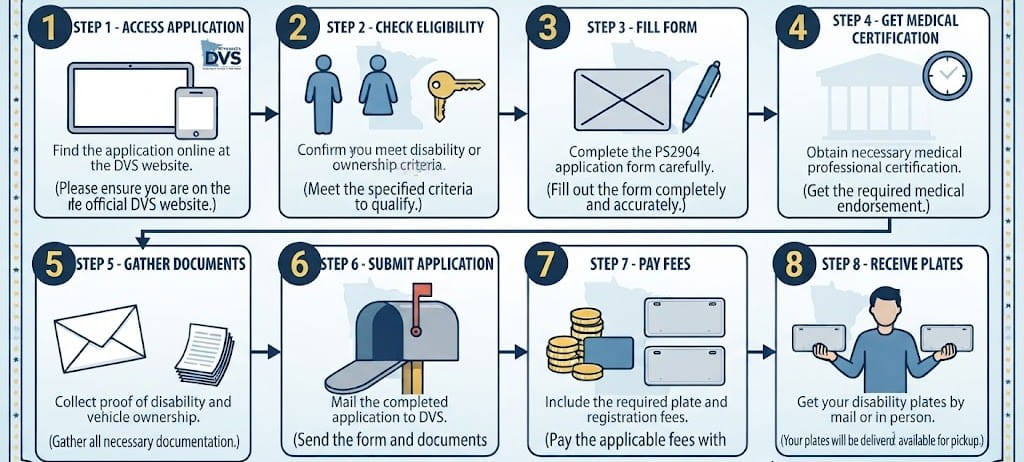
- Official Minnesota DVS Page: This is the official disability license plates page of the Minnesota Department of Public Safety, Driver and Vehicle Services (DVS).
- Eligibility Information: The page explains that disability plates may be available to a vehicle owner or primary operator who meets the qualifying disability requirements, a custodial parent or guardian of a permanently disabled minor, or certain owners of specially modified commercial rental vehicles.
- Application Form: The page provides the official Disability License Plate Application (PS2904) for applicants who qualify for disability plates.
- Where to Submit: DVS recommends visiting a local deputy registrar office for faster service when submitting the disability plate application.
- Mail Option: Applicants can submit the application by mail. DVS states that mailed applications may take longer to process, and an application can be returned if the required fees are incorrect.
- Mailing Address: For mailed applications, the DVS page lists 445 Minnesota St., St. Paul, MN 55101-5187 as the mailing address.
- Fees: The DVS page lists a fee for standard disability plates and a fee for motorcycle disability plates.
- Second Set: Applicants requesting a second set of disability plates may need to complete a separate questionnaire or application as specified by DVS.
What Documents Are Needed for Disability Plates?
The documentation needed for Minnesota disability plates depends on the type of plate request and the applicant’s circumstances. The application may require personal details, vehicle information, current registration or plate details, and medical certification showing that the applicant meets the qualifying requirements. Applicants should use the current Minnesota DVS application and provide complete information to avoid delays. A disability parking certificate number may be relevant where the applicant already has qualifying parking privileges. Other supporting records, such as veteran documentation or transfer information, may apply in specific situations.
Disability Parking Certificate Number
If applicable, provide the disability parking certificate number requested on the application. This can help connect an existing disability parking credential with the plate request.
Medical Statement or Proof
A medical statement or other required medical certification may be needed to establish eligibility. The appropriate health professional must complete the medical portion of the application when required by DVS.
Vehicle and Plate Information
Have the vehicle’s year, make, model, vehicle identification number (VIN), registration details, and current plate information available. Transfer requests may require information about the existing plate or registration being transferred.
Insurance Information
Current insurance information may be requested as part of the vehicle registration transaction. Keep the relevant insurance details available when submitting the application.
Identification and Contact Information
The application can require the applicant’s name, address, phone number, and other identifying details. Use current information so DVS or the registration office can contact the applicant if additional documentation is needed.
Veteran or Transfer Documentation
Applicants requesting disability plates connected with veteran status may need applicable veteran documentation. For a plate transfer provide the existing registration and plate details requested by DVS. Requirements can vary by transaction type, so applicants should check the current DVS application before submission.
What Documents Are Needed for Disability Plates?
The documents needed for Minnesota disability plates depend on the plate type, vehicle, and applicant’s situation. Applicants may need medical certification, disability parking information, vehicle details, insurance information, identification, or supporting records for veteran or transfer requests. Before submitting an application, check the current Minnesota DVS requirements and use the correct application form. Having the required information ready can help reduce delays caused by missing or incomplete documentation.
Disability Parking Certificate Number
If applicable, provide the disability parking certificate number requested on the application.
- Current disability parking certificate number
- Permanent disability parking information, when applicable
- Certificate details requested by the Minnesota DVS application
- Any related information needed to verify existing disability parking privileges
Medical Statement or Proof
Medical documentation may be required when the applicant does not have another qualifying form of disability certification.
- Medical statement completed by an eligible health professional
- Proof of a qualifying physical disability
- Required medical certification included with the application
- Health professional information requested on the form
Vehicle and Plate Information
Applicants should have the vehicle and current registration information available before completing the application.
- Vehicle year
- Vehicle make and model
- Vehicle Identification Number (VIN)
- Current Minnesota registration information
- Current license plate number
- Existing plate information for a transfer request
Insurance Information
Current insurance details may be requested as part of the registration transaction.
- Current vehicle insurance information
- Insurance details required by the registration application
- Policy information, when requested
- Current vehicle information matching the registration record
Identification and Contact Information
The application may request personal and contact details for the applicant.
- Full legal name
- Current address
- Mailing address, when different
- Phone number
- Other identifying information requested on the application
Veteran or Transfer Documentation
Additional documentation may apply to certain veteran-related disability plate requests or plate transfers.
- Applicable veteran documentation, when required
- Existing registration information
- Current plate number
- Transfer details requested by DVS
- Other supporting documents listed on the current application
Disability Plate Types
Minnesota offers several disability plate options based on the type of vehicle and the applicant’s circumstances. The current DVS materials identify disability plate eligibility for passenger vehicles, one-ton pickups, self-propelled recreational vehicles, mopeds, and motorcycles. The appropriate plate type depends on the vehicle being registered and the applicable DVS requirements.
Standard Disability Plates
A standard disability plate is intended for qualifying passenger vehicles and other vehicle categories covered by Minnesota DVS. These plates identify the vehicle as registered under Minnesota’s disability plate program and are issued after the applicant meets the required eligibility and documentation requirements.
Specialty Disability Plates
A specialty disability plate may refer to disability plates associated with a specific qualifying vehicle category or specialty designation. Applicants should check the current DVS materials to determine which plate choices are available for their vehicle rather than assuming every specialty plate can be issued with a disability designation.
Motorcycle Disability Plates
A motorcycle disability plate is available for qualifying motorcycles. The motorcycle must meet Minnesota registration requirements, and the applicant must satisfy the disability plate eligibility rules. The application and applicable fees differ from some passenger-vehicle transactions.
Moped Disability Plates
Minnesota DVS materials include moped eligibility within the disability plate program. Applicants registering a qualifying moped should select the applicable vehicle category on the current application and provide the required registration and disability documentation.
Veteran/Military Disability Plates
A veteran disability plate may involve additional eligibility requirements when a disability plate request is connected with veteran or military status. Applicants should provide any required veteran documentation and confirm the available plate designation with DVS before submitting the application.
Disability License Plate Fees
Minnesota disability plate fees can include the plate charge, vehicle registration fee, filing or transaction charges, and additional costs for certain special designs. The exact Minnesota disability plate cost depends on the vehicle, plate type, registration transaction, and any optional designation selected. Current DVS materials list for standard double plates and for single or motorcycle plates for initial and replacement plates.
| Fee Type | Current Fee | Details |
|---|---|---|
| Standard Disability Plate | $15.50 | Initial or replacement standard plates |
| Motorcycle Disability Plate | $13.50 | Initial or replacement motorcycle plates |
| Moped Disability Plate | $15.50 | Standard plate fee structure; confirm transaction-specific charges with DVS |
| Personalization Fee | $100 | Initial issuance of a personalized plate; regular fees apply for replacement |
| Registration Fee | Varies | Depends on vehicle type, registration class, and transaction |
| Filing / Transaction Fee | Varies | May apply based on the transaction |
| Special Plate Contribution | Varies | Applies to certain special plate designs or organizations |
| Plate Transfer Fee | Varies | Applies when transferring plates, depending on the transaction |
Disability Parking Privileges With Plates
Minnesota disability plates provide specific disability parking privileges when the vehicle is being used by or for the sole benefit of a qualifying disabled person. A vehicle displaying valid disability plates may use designated accessible parking spaces and certain metered or time-limited spaces under Minnesota law. These privileges apply only when the legal requirements are met and do not permit parking in locations where parking is otherwise prohibited.
Designated Accessible Spaces
- A vehicle displaying valid disability plates may park in a designated accessible parking space.
- The vehicle must visibly display the required disability plate or qualifying parking certificate.
- Accessible spaces and their associated access aisles must remain available for qualifying users.
Metered Parking
- Disability parking permits parking in qualifying metered spaces without paying the meter fee.
- The privilege applies without a time restriction unless an official sign separately establishes a time limit.
- Local signs and parking rules can establish restrictions that still apply.
Time-Limit Privileges
- A vehicle may park without the normal time limit in certain nonmetered passenger-vehicle spaces.
- The space must otherwise allow passenger-vehicle parking and must not specifically prohibit disability parking privileges.
- Certain local long-term parking programs can establish additional limits.
Who May Use the Parking Privilege
- The qualifying disabled person may use the vehicle for disability parking.
- Another person may park the vehicle for the qualifying person when actually transporting that person for their sole benefit.
- The vehicle must display a valid disability plate, certificate, or other qualifying credential.
Transportation of the Qualifying Disabled Person
A driver transporting a qualifying disabled person may use the parking privilege when the vehicle is being used for that person’s benefit. For certain designated or metered spaces, the driver must actually be transporting the qualifying person, and the parking location must be within a reasonable distance from the drop-off point.
Restrictions
- Disability parking privileges do not permit parking in designated no-parking areas.
- They do not permit parking in spaces reserved for specific purposes or vehicles.
- They do not permit parking where other state or local restrictions prohibit parking.
- Misuse of disability plates or parking credentials can result in penalties and loss of parking privileges.
Disability Plate Renewal
Minnesota disability license plate renewal is connected with the vehicle registration process. The disability plate remains assigned to the registered vehicle, while the vehicle registration must be renewed for each registration period. Owners should renew the registration before it expires and keep the registration and vehicle information current. The exact fees and renewal requirements can vary based on the vehicle and registration transaction.
Plate Validity Through Vehicle Registration
A Minnesota disability plate remains associated with the vehicle registration. The registration expiration date determines when the vehicle needs a new registration period. The registration sticker shows the current registration period and should remain properly displayed on the vehicle.
Registration Renewal
Registration renewal keeps the vehicle legally registered for the next registration period. During renewal, the owner may need to pay applicable registration taxes and fees and confirm current vehicle and owner information. Disability plate owners follow the same registration renewal process applicable to their vehicle.
What Happens When Registration Expires
When registration expires, the vehicle does not have current registration for normal operation on Minnesota roads. The owner needs to complete the required registration renewal before continuing to operate the vehicle. Additional requirements or charges may apply to an expired registration transaction.
Updating Vehicle or Owner Information
Owners should keep their address, vehicle, and registration information current. If disability plates are transferred to another qualifying vehicle, the transfer must meet Minnesota DVS requirements. Changes in ownership or other registration details may require additional documentation.
Can Disability Plates Be Transferred to Another Vehicle?
Minnesota disability plates can be transferred to a qualifying replacement vehicle when the required conditions are met. Minnesota law allows the disability plate transfer after the owner notifies the commissioner. The replacement vehicle must meet the applicable vehicle-class requirements and must be owned or primarily operated by the permanently physically disabled person.
Replacement Vehicle
A disability plate can move from the original vehicle to a replacement vehicle when the replacement vehicle qualifies under Minnesota law. The transfer applies to eligible vehicle types listed in the statute.
Notification
The owner must notify the commissioner when transferring disability plates to a replacement vehicle. The transfer should be handled as part of the vehicle registration process, with the required vehicle and ownership information.
Ownership or Primary Operation Requirement
The replacement vehicle must be owned or primarily operated by the permanently physically disabled person. This requirement determines whether the existing disability plate can remain assigned to the replacement vehicle.
Vehicle-Class Requirement
The replacement vehicle must fall within an eligible vehicle category. For a single disability plate issued for a motorcycle or motorized bicycle, the replacement vehicle must be the same applicable vehicle class.
What Happens When a Vehicle Is Sold
When ownership of the original vehicle is transferred, the seller must remove the disability plates. The buyer can receive regular plates for the vehicle without an additional plate cost for the remainder of the current registration period.
Disability Plates for Veterans and Military Members
Minnesota offers veteran & military plate options, but veteran status alone does not automatically qualify someone for disability plates. A disabled veteran may need to meet the state’s disability requirements and provide the documentation required for the selected plate type. Veteran-specific plates can have separate military service requirements.
Disabled Veteran Plates
- Veteran-specific plates may be available to qualifying disabled veterans.
- Eligibility can depend on military service and the type of veteran plate requested.
- Some plate types may require proof of a service-connected disability.
- Veteran plate requirements are separate from standard disability plate eligibility.
Disability Symbol
- Minnesota disability plates display the recognized wheelchair symbol.
- The symbol identifies the vehicle as displaying disability plates.
- The disability symbol is connected with the parking privileges provided under Minnesota law.
- Parking privileges still depend on the applicable disability parking rules.
Veteran Eligibility Documentation
Applicants may need documentation showing qualifying military service, such as:
- DD-214 or an equivalent separation document
- Military service information requested by DVS
- Disability documentation when required for a specific veteran plate
- Other supporting records listed for the selected plate type
Relationship Between Veteran Status and Disability Qualification
- Being a veteran does not automatically establish eligibility for disability plates.
- A qualifying permanent physical disability may be required for disability plates.
- Veteran status can provide eligibility for separate veteran plate categories.
- An applicant may need both disability-related documentation and veteran documentation when requesting a plate that involves both qualifications.
Frequently Asked Questions
Minnesota License Plate information often raises questions about eligibility, applications, parking privileges, renewal, transfers, and replacement requirements. These frequently asked questions cover concerns about Minnesota disability plates, including who may qualify, whether a placard is required, who can drive a vehicle displaying disability plates, parking at meters, and transferring plates to another vehicle. Each answer focuses on the basic Minnesota rules and requirements that applicants and vehicle owners may need to know before completing a disability plate transaction.
Who qualifies for a disability license plate in Minnesota?
Minnesota disability plates are available when an eligible vehicle is owned or primarily operated by a permanently physically disabled person, or by a qualifying custodial parent or guardian of a permanently physically disabled minor. The applicant generally needs to provide a medical statement or acceptable proof of physical disability when first applying. Minnesota law covers passenger vehicles and certain other vehicle types, including motorcycles, motorized bicycles, one-ton pickup trucks, and self-propelled recreational vehicles.
Can I get disability plates without a placard?
A disability parking placard or certificate is not the only way to qualify for Minnesota disability plates. When applying for disability plates, the applicant can provide the required medical statement or other acceptable proof of physical disability. The current DVS application states that applicants who do not have a Disability Parking Certificate for a permanent disability must complete the applicable medical certification section.
Can someone else drive a vehicle with disability plates?
Another person may drive a vehicle displaying Minnesota disability plates in certain situations. Minnesota law permits a non-disabled driver to operate the vehicle with the consent of the disabled owner or when a qualifying custodial parent or guardian is transporting a permanently disabled minor. The driver does not receive the disability parking privileges simply by driving the vehicle; those privileges must be used for or on behalf of the qualifying disabled person.
Do disability plates allow free parking at meters?
Minnesota disability plates can provide free parking at qualifying metered spaces. State law permits a vehicle displaying disability plates to park in a metered space without paying the meter fee and without the usual time restriction, unless an official sign separately establishes a time restriction. Disability parking privileges do not allow parking in designated no-parking areas, spaces reserved for specific purposes, or locations restricted by applicable law.
Can I transfer Minnesota disability plates to another vehicle?
Minnesota disability plates may be transferred to a qualifying replacement vehicle after notification to the commissioner. The replacement vehicle must meet the applicable vehicle-class requirement and must be owned or primarily operated by the permanently physically disabled person. When the original vehicle is sold, the disability plates must be removed from that vehicle. The current DVS disability plate application specifically includes a section for transferring disability plates to another vehicle.