Minnesota License Plate options for collector vehicles provide a registration choice for owners who preserve older cars, trucks, and other qualifying vehicles. Collector plates can connect a vehicle’s registration with its historical or collectible status, subject to Minnesota requirements for eligibility, vehicle use, documentation, and fees. Owners should check the current rules before applying, since plate categories can have specific conditions related to vehicle age, operation, and registration. Knowing the applicable requirements can help vehicle owners prepare the paperwork and select a plate type that fits their collector vehicle.
Minnesota License Plate information for collector vehicles can help owners compare plate requirements, eligibility rules, fees, and registration details before submitting an application. Collector-related plates may apply to qualifying older or collectible vehicles, with Minnesota setting conditions for vehicle age, ownership, use, and registration. Some plate types can carry restrictions on how the vehicle is operated or used on public roads. Reviewing the state requirements and registration materials can help owners identify the collector plate category and avoid using a plate option that does not match their vehicle’s status.
Collector Plate Eligibility Requirements
Minnesota Collector Plate Rules set specific conditions for vehicles seeking Collector Class registration. The main vehicle eligibility requirements relate to the vehicle’s model year, collector-only use, ownership of another regularly registered vehicle, and, for certain newer vehicles, production volume. Minnesota DVS identifies Collector Class vehicles as self-propelled motor vehicles that are at least 20 model years old, or vehicles that are at least 10 model years old when no more than 500 were manufactured or imported into the United States.
Vehicle Age Requirements
Under MN Collector Plate Rules, the standard Collector Class age threshold is at least 20 model years old. Minnesota provides a separate exception for a vehicle that is 10 model years old when no more than 500 vehicles were manufactured or imported into the United States. This means the model year alone does not determine every vehicle’s eligibility. Motorcycles have their own Collector Class requirement and must be at least 20 model years old.
Collector-Only Vehicle Use
A qualifying collector vehicle must be owned and operated solely as a collector’s item rather than for general transportation. Minnesota’s vehicle registration instructions define Collector use in these terms. This distinction means Collector Class registration is tied to the vehicle’s permitted use, not simply its age. The owner must certify the vehicle’s qualifying use when applying for the special plate classification.
Regular Vehicle Requirement
The owner must have one or more other vehicles registered in their name with regular Minnesota license plate and that registration must be current when applying for Collector Class plates. The special-plate application includes a section for identifying the vehicle owned or leased and registered for general transportation.
Manufacturer Production Statement
For the 10-year vehicle exception, the vehicle must have had no more than 500 units manufactured or imported into the United States. Supporting documentation or a manufacturer statement may be relevant to establishing this production limit. This exception allows certain limited-production vehicles to qualify before reaching the standard 20-model-year threshold.
Affidavit and Vehicle Information
The application process requires vehicle and ownership information, including the vehicle identification number (VIN), make, model year, and ownership details. The applicant must certify the qualifying Collector use and identify a regular Minnesota-plated vehicle where required. The official special-plate application contains the Collector section and certification requirements.
How to Get Collector Plates in MN
How to Get Collector Plates in MN starts with confirming that the vehicle meets Minnesota’s collector-class requirements and that the owner can satisfy the registration conditions. Minnesota classifies a vehicle as a collector when it is generally at least 20 model years old, or at least 10 model years old when no more than 500 were manufactured or imported into the United States. The vehicle must be owned and operated solely as a collector’s item rather than for general transportation. The owner must have at least one other vehicle registered in their name with current regular Minnesota plates.
- Minnesota DVS Collector Class Specialized License Plates:
- https://dps.mn.gov/divisions/dvs/vehicle/license-plates/specialized-license-plates/collector-class-classic-street-rod-pioneer-and-classic-motorcycle-specialized-license-plates
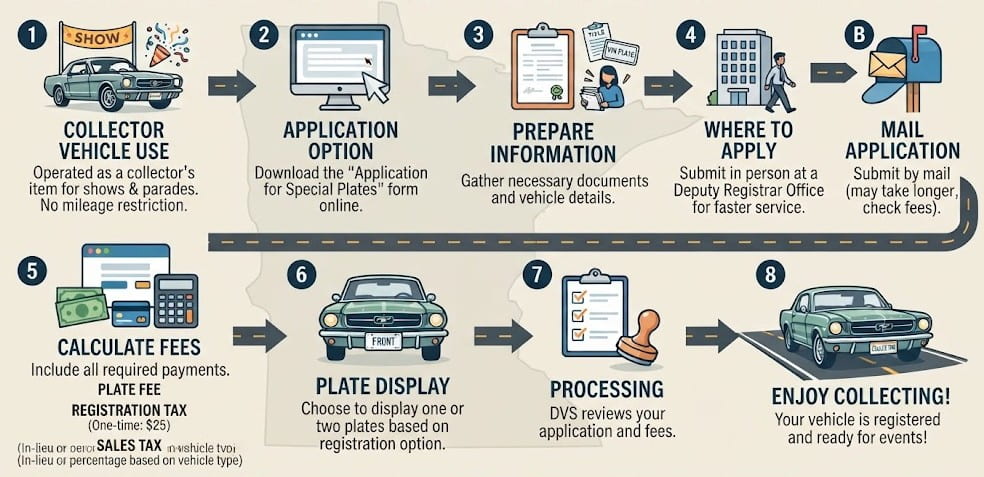
- Collector Vehicle Use: According to Minnesota DVS, Collector Class vehicles are operated as collector’s items. Driving for collector events, such as shows and parades, is permitted. The DVS page does not list a mileage restriction for collector vehicles.
- Where to Apply: A Collector Plate application can be submitted at the nearest deputy registrar office. DVS lists visiting a deputy registrar office as an option for faster service.
- Application Option: The DVS page provides an official link to the Application for Special Plates, which is the relevant form for requesting special plates.
- Plate Fee: The listed Collector Class plate fee is for a single plate and for a double plate.
- Registration Tax: An initial Collector Class application has a one-time registration tax listed by DVS.
- Sales Tax: For passenger vehicles and fire trucks, a $150 in-lieu tax applies to collector classes. For commercial trucks, one-ton pickups, and motorcycles, DVS lists 6.875% of the purchase price or fair market value.
- Plate Display: A Collector Class vehicle can display one or two license plates, based on the applicable registration option.
- Mail Application: An application can be submitted by mail. DVS states that mailed applications may take longer to process, and an application can be returned if the submitted fees are incorrect.
Collector Plate Fees and Taxes
Minnesota Licese Plate costs for Collector Class registration can involve different charges based on the vehicle and registration type. Minnesota Collector Plates have specific registration and plate-related charges that are separate from the standard requirements for regular vehicle registration. The total amount can depend on the plate type, registration transaction, and other applicable charges. This section explains the main taxes, plate charges, and registration-related costs associated with Collector Class vehicles under Minnesota rules.
| Fee or Tax | Amount / Details |
|---|---|
| Collector-Class Registration Tax | $25 one-time tax under Minnesota Statutes §168.10 |
| Double Collector Plate Fee | $15.50 for a standard double-plate set |
| Single Collector Plate Fee | $13.50 for a single plate |
| Collector Motorcycle Plate Fee | $13.50 |
| Plate Manufacturing / Issuance | Included in the applicable plate fee listed by DVS |
| Registration-Related Charges | Additional title, registration, filing, or administrative charges may apply |
| Other Tax Considerations | Taxes can vary based on the vehicle, purchase, ownership, and registration circumstances |
| Total Cost | Depends on the applicable Collector Class tax, plate option, and other registration charges |
Can You Use Original License Plates on a Historic Vehicle?
Minnesota law allows certain qualifying historic and collector vehicles to use original Minnesota plates that match the vehicle’s model year. The plate must meet applicable requirements for condition, number verification, and registration. Owners may need to address an existing collector plate registration before switching to an original period plate. The process is different from displaying an old plate for decoration, since the plate must be legally recognized for use on the vehicle.
Original Minnesota Plates
Minnesota law allows certain qualifying historic or collector vehicles to use original Minnesota plates from the same model year as the vehicle, provided the statutory requirements are met. An old plate cannot simply be placed on a vehicle for display without meeting the applicable registration conditions. The plate must be an authentic Minnesota plate and must qualify for the historical plate option.
Matching Model Year
The original plate must correspond to the same model year as the qualifying vehicle. This requirement connects the period plate with the vehicle being registered. Owners should check the plate year and vehicle model year before requesting this type of registration. A plate from a different model year may not meet the requirements for use on the vehicle.
Plate Condition
The original Minnesota plate should be in suitable condition for legal display. The plate number must remain identifiable, and the plate should not be damaged to the point that its information cannot be clearly recognized. A severely damaged or illegible plate may create an issue during the registration process.
Number Verification
Minnesota DVS may need to verify the original plate number before it can be used on a historic vehicle. The number must be checked against Minnesota registration records to confirm that it does not create a conflict with another active plate number. This verification helps determine whether the original plate can be assigned to the vehicle.
Duplicate or Conflicting Number
An original plate cannot be used if its number conflicts with another Minnesota registration or creates a duplicate assignment. If the plate number is already associated with another vehicle, DVS may require a different registration arrangement before the original plate can be approved for use.
Replacing Current Collector Plates
If the vehicle currently has Collector Plates, the existing collector registration must be addressed before switching to an original period plate. The owner should complete the required registration change through Minnesota DVS or a deputy registrar rather than simply removing the current plates and installing the original plates.
Registration Verification
Using historic plates or antique vehicle plates does not remove the applicable registration requirements. Owners should have the original plate, vehicle information, and registration status checked by Minnesota DVS or a deputy registrar before using the plate on public roads.
One Plate vs Two Plates for Collector Vehicles
Minnesota License Plate requirements can differ based on the type of collector vehicle registration and the number of plates issued. Minnesota collector vehicles may be registered with a single plate or a pair of plates, depending on the applicable registration option. The plate fee can differ between single and double plates, and display requirements determine where the plate is placed on the vehicle. Reviewing the differences between one and two plates can help vehicle owners identify the applicable plate setup for their Minnesota collector registration.
| Feature | One Collector Plate | Two Collector Plates |
|---|---|---|
| Number of Plates | 1 plate | 2 plates |
| Display Location | Rear of the vehicle | Front and rear of the vehicle |
| Collector Class | Available for applicable collector registrations | Available for applicable collector registrations |
| Plate Number | One assigned registration plate | Both plates carry the same assigned number |
| Vehicle Model Year | Vehicle must meet the applicable Collector Class requirements | Vehicle must meet the applicable Collector Class requirements |
| Registration | Must comply with Minnesota Collector Class registration requirements | Must comply with Minnesota Collector Class registration requirements |
| Display Choice | Used where the single-plate option applies | Used where the double-plate option applies |
Can Collector Plates Be Transferred?
Minnesota License Plate transfer rules can apply when a collector plate is moved from one qualifying vehicle to another. The receiving vehicle must meet the requirements for the applicable collector classification, and ownership details can affect whether the transfer is permitted. A transfer fee may apply, along with specific registration requirements for the vehicle receiving the plate. Reviewing the owner, vehicle, and registration conditions can help clarify when a collector plate transfer is allowed and when a different plate application may be required.
Key requirements include:
- Transfer Fee: A $5 transfer fee may apply when eligible collector plates are transferred to another qualifying vehicle.
- Eligible Receiving Vehicle: The vehicle receiving the collector plates must meet the requirements for the applicable collector classification.
- Owner or Joint Ownership: The transfer may be permitted when the plate owner remains the owner of the receiving vehicle or when the ownership arrangement meets Minnesota registration requirements.
- New Owner Requirements: If ownership changes, the new owner must meet the applicable requirements for collector registration before the plates can remain valid.
- Ineligible Vehicle Restriction: Collector plates cannot be transferred to a vehicle that does not qualify for the required collector classification.
- Registration Records: Ownership and vehicle information must be updated with Minnesota DVS or a deputy registrar when the transfer is processed.
Collector Plates vs Regular Plates
Minnesota License Plate options differ based on the vehicle’s registration classification, intended use, and eligibility. Collector plates are available only for vehicles that meet Minnesota’s specific Collector Class requirements, so an older vehicle does not automatically qualify. Regular plates follow the standard registration process and are generally used for everyday vehicle transportation. The differences can include vehicle age, documentation, taxes and fees, plate renewal transfer rules, and restrictions. Comparing these points helps show how Collector Class registration differs from a regular Minnesota vehicle registration.
| Feature | Minnesota Collector Plates | Regular Plates |
|---|---|---|
| Eligibility | Vehicle must meet Minnesota Collector Class requirements. | Vehicle follows standard Minnesota registration requirements. |
| Vehicle Use | Intended for qualifying vehicles operated as collector’s items. | Used for normal personal, commercial, or other permitted transportation. |
| Vehicle Age | Generally requires at least 20 model years, with a limited-production exception for certain vehicles. | No collector-age requirement applies. |
| Documentation | May require collector-specific application, affidavit, and vehicle information. | Standard title and registration documents apply. |
| Taxes & Fees | Collector registration has specific tax and plate-fee requirements. | Standard registration taxes and applicable plate fees apply. |
| Plate Display | Uses a specialized collector plate issued under the applicable classification. | Uses standard Minnesota registration plates or another applicable regular plate type. |
| Renewal | Collector registration has separate renewal rules under Minnesota law. | Regular registration follows the standard renewal cycle. |
| Transfer | Collector plates may be transferred when statutory requirements are met. | Plate and registration transfers follow standard Minnesota rules. |
| Restrictions | Collector-use and vehicle eligibility requirements apply. | Standard registration restrictions apply rather than Collector Class conditions. |
Frequently Asked Questions
Minnesota License Plate questions often focus on vehicle age, Collector Class eligibility, limited-production vehicles, permitted use, and other registration conditions. Minnesota Collector Plates have requirements that differ from regular vehicle plates, and meeting the vehicle-age requirement alone does not automatically establish eligibility. The questions below address common points about collector vehicle registration, including the 20-year requirement, the 500-vehicle exception, permitted vehicle use, and the requirement for another vehicle with regular Minnesota plates.
How Old Does a Vehicle Have to Be for Collector Plates in Minnesota?
Minnesota Collector Plates generally require a vehicle to be at least 20 model years old under the Collector Class requirements. The vehicle must meet the other eligibility conditions as well, including collector-use requirements and applicable ownership and registration conditions. Vehicle age by itself does not qualify a vehicle for Collector Class registration.
Can a 10-Year-Old Vehicle Qualify?
A 10-year-old vehicle can qualify in a limited situation. Minnesota law allows a vehicle that is at least 10 years old to qualify when no more than 500 motor vehicles of that make and model were manufactured or imported into the United States. Supporting information may be required to establish that the vehicle meets this limited-production requirement.
What Is the 500-Vehicle Rule?
The 500-vehicle rule is an exception to the standard 20-year age requirement. A vehicle that is at least 10 model years old may qualify for Collector Class registration if 500 or fewer vehicles of that make and model were manufactured or imported into the United States. The applicant may need documentation or a manufacturer’s statement confirming the production or importation limit.
Can I Use Collector Plates for Everyday Driving?
Collector Plates are intended for vehicles owned and operated solely as collector’s items, rather than ordinary transportation. Minnesota law permits collector vehicles to be operated for purposes connected with their collector status, such as exhibitions, shows, parades, and similar activities. Collector registration should not be treated as a standard substitute for regular vehicle registration used for everyday transportation.
Do I Need Another Vehicle With Regular Plates?
Minnesota Collector Class requirements generally require the owner to have one or more other motor vehicles registered in the owner’s name with regular Minnesota plates. This condition helps distinguish a collector vehicle from a vehicle being registered for ordinary transportation. The other vehicle must have current regular Minnesota registration as required by the applicable Collector Class rules.